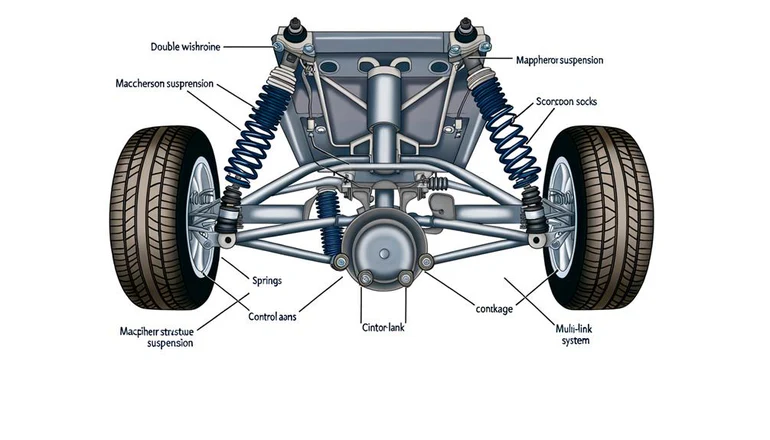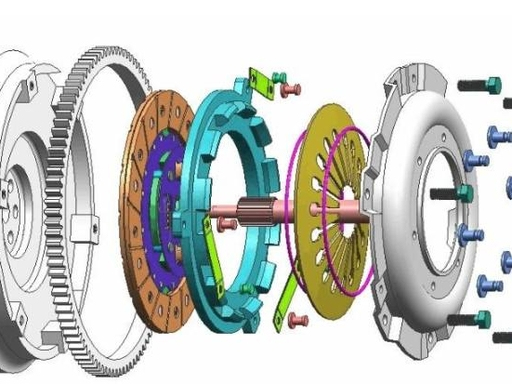
In recent years, with the steady growth of global automobile sales, the scale of the automotive parts market has continued to expand. Automotive parts refer to various units and components that constitute the entire automobile and serve it. These parts are indispensable in the process of automobile manufacturing and maintenance, covering a wide range of areas from engines, transmission systems, braking systems, steering systems, and driving systems to electrical systems, vehicle bodies and accessories. Together they form the entirety of an automobile and determine its performance, safety, comfort and environmental friendliness.
There is a wide variety of automotive parts, ranging from large components such as engines, transmissions and body frames to small parts like bolts, nuts, sensors and wires, all of which fall under the category of automotive components. The quality and performance of these parts directly affect the overall quality and performance of vehicles, so both automobile manufacturers and parts suppliers attach great importance to the research and development, manufacturing and quality control of components.
Current Development Status of the Automotive Parts Industry and Analysis of Its Import and Export Market
The automotive parts industry chain consists of upstream raw material supply, midstream parts manufacturing, and downstream vehicle assembly as well as the after-sales market. The quality and price of upstream raw materials directly affect the cost and quality of components; midstream manufacturers need to continuously improve processing technology and quality control capabilities; the downstream sector is required to respond quickly to market changes and provide efficient after-sales services.
According to statistics, the global market size of auto parts reached approximately 1,340.04 billion yuan in 2023 and is projected to reach 1,574.26 billion yuan by 2030, with a compound annual growth rate (CAGR) of 2.3% from 2024 to 2030. Among them, China’s auto parts market has been expanding continuously. In 2023, China’s auto parts exports reached 88.4 billion US dollars, a year-on-year increase of 9.1%. This growth momentum is attributed to the continuously improving technical capabilities and product quality of domestic auto parts enterprises, as well as the trend of global procurement.
According to the Report on the Development Trends and Investment Strategy Forecast of China’s Auto Parts Industry from 2024 to 2029 issued by CRI Research Industry Research Institute:
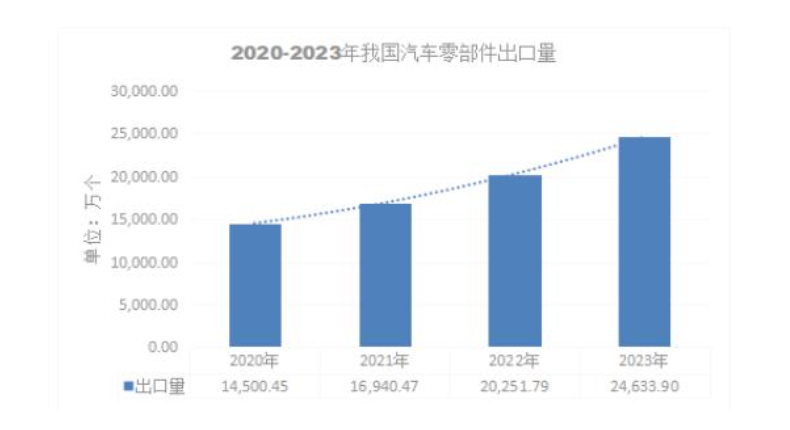
In recent years, the export volume of China’s auto parts products has maintained a steady growth trend and is expected to continue growing in the future. According to data, the export quantity of auto parts increased from 145 million units in 2020 to 246 million units in 2023. Affected by the pandemic, the growth rate of China’s auto parts export volume gradually accelerated from 2021 to 2023.
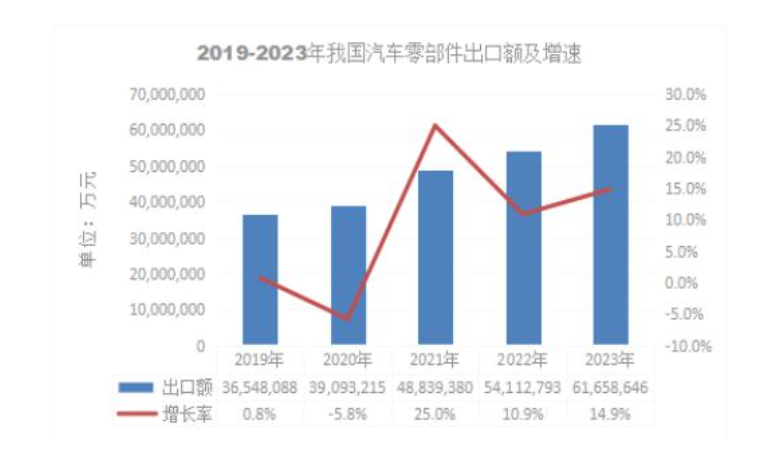
Judging from data in recent years, China’s export volume of auto parts has maintained continuous growth, indicating that the competitiveness of China’s automobile industry in the global market is constantly improving. In 2020, China’s auto parts exports reached 390.932 billion yuan, a year-on-year decrease of 5.8%. By 2021, China’s auto parts exports grew significantly with a growth rate of 25.0%. Although the growth rate dropped noticeably in 2022, it rebounded further in 2023, with the export volume reaching 616.586 billion yuan.
The rapid development of new energy vehicles has brought new growth points to the automotive parts industry. As the penetration rate of new energy vehicles continues to rise, the demand for related components such as batteries, electric motors, and electronic control systems keeps growing. New technologies including intelligence, lightweighting, energy conservation and environmental protection have become important directions for industrial development, offering new development opportunities for the automotive parts sector. Amid the wave of globalized parts procurement, the international competitiveness of China’s automotive parts industry is constantly increasing, with its export volume continuing to rise.
Problems such as insufficient strategic planning, pressure to improve quality, and unreasonable production management still exist. Intensified market competition requires enterprises to continuously enhance their technological capabilities and product quality to adapt to market changes. Factors including fluctuations in raw material prices and international trade frictions may also exert a certain impact on the automotive parts industry.
Forecast of Future Development Trends in the Automotive Parts Industry
With the rapid development of new energy vehicles and intelligent driving technology, the automotive parts industry is undergoing profound changes. In terms of electrification, the popularization of new energy vehicles has driven the growth in demand for key components such as batteries, electric motors, and electronic controls; in terms of intelligence, the widespread adoption of intelligent driving technology has boosted the penetration rate of high-end components including sensors, lidars, and cameras.
The trend toward lightweight and electrified automobiles will drive the rapid growth of components in related fields, and components made of lightweight materials such as aluminum alloys still offer considerable room for development. Meanwhile, as global environmental awareness increases and the energy structure transforms, the automotive parts industry must also place greater emphasis on environmental protection and sustainable development. Amid the wave of globalized parts procurement, the international competitiveness of China’s automotive parts industry continues to rise. Furthermore, driven by the growing demand for automobiles in emerging markets and an abundant labor supply, the global automotive industrial chain is gradually shifting toward Asia, particularly China.
In summary, the current market situation of the automotive parts industry is characterized by a continuously expanding market scale, a well-developed industrial chain structure, a diversified competitive landscape, and the coexistence of opportunities and challenges. In the future, with the development of trends such as electrification, intelligence, and lightweighting, as well as the advancement of global procurement and industrial transfer, the automotive parts industry will embrace more development opportunities and challenges.