Cooling System

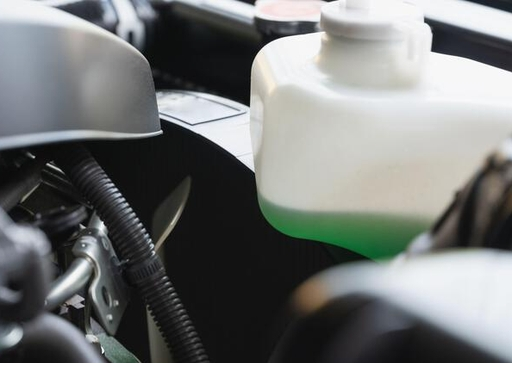
Professional-grade automotive cooling system featuring a high-efficiency tube-and-fin radiator with a large heat dissipation area and high efficiency, capable of a cing power of 5-20kW to meet the needs of engines with different displacements. The water pump employs a precision bearing design with stable rotation speed and controllableflow rate (5-15L/min), ensuring excellent sealing performance and eliminating leakage risks; the thermostat offers temperature control accuracy ≤±2℃, enabling precise switching between large and small circulatps to ensure rapid engine warm-up and stable heat dissipation. The cooling fan features intelligent temperature control, automatically adjusting its speed (100r/min) based on coolant temperature, with noise ≤55dB for energy-saving and quiet operation. Core components are made of corrosion-resistant and high-temperature special materials, having undergone multiple ets including high/low temperature, cyclic fatigue, and salt spray corrosion. Compatible with 12V/24V vehicle voltages, it balances heat dissipation performance, structura durability, and energy efficiency, suitable for high-end passenger cars, commercial vehicles, special vehicles, and various other scenarios..

       Common Fault Analysis of EA839 Engine (2.9T/3.0T)

        As the latest high-end powertrain core under the Volkswagen Group, the EA839 engine comes in two displacements: 2.9T and 3.0T. It is widely equipped in a variety of high-end models of Audi, Porsche and Volkswagen, covering:

      ✅ Audi: A6L-C8, A8L, Q8, A7L, Q7, etc.;

      ✅ Volkswagen: Touareg;

      ✅ Porsche: Cayenne, Panamera.
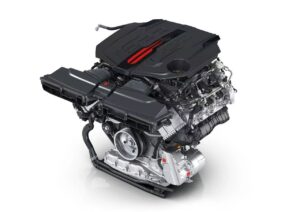
                                                               

        As a star powertrain of the Volkswagen Group, the EA839 2.9T/3.0T engine delivers strong power and adopts cutting-edge technology. However, many car owners encounter problems after driving it for a few years: unexplained high water temperature, intermittent cooling of the air conditioner, continuous coolant leakage despite repeated refills, as well as oil seepage at the oil filter base and rattling abnormal engine noise. Most of these issues stem from hidden risks caused by inherent design flaws. Today, we break down the root causes, typical symptoms and permanent solutions for the four core components of the cooling system plus two highly frequent mechanical faults. Whether you are a car owner or an automotive repair professional, this guide will help you avoid detours — it is recommended to bookmark it for future reference!

       I. Water pump assembly failure (frequent common fault, core inducing factor)

        Part Number: 06M121013G. This original-equipment water pump assembly features a four-hole mounting flange design. The water pump and pulley are fastened together solely by four bolts. Despite its seemingly simple structure, it has inherent design flaws. The engine operates continuously under high-temperature and high-pressure conditions. The four-hole flange has very few stress-bearing points with highly concentrated loads. Under the repeated stress of thermal expansion and contraction over time, the flange is prone to deformation and accelerated aging of sealing components, further causing internal and external coolant leaks. This is the most common and prevalent original factory inherent fault of the EA839 engine.
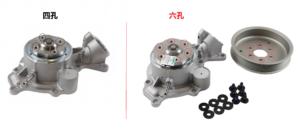
                                                                     

✅Solution: Replace with the newly upgraded six-hole water pump assembly. The upgraded version is standardly equipped with a six-hole fixing flange, a six-hole pulley and 6 dedicated fixing bolts, which fundamentally resolves the defects of the old model in terms of structure. By adding fixing points and increasing the contact diameter of the flange, it effectively disperses the stress load on each single bolt, and greatly improves the structural strength and sealing durability of the flange. The assembly supports direct in-situ replacement without damage, with no need to modify any surrounding components. It structurally makes up for the inherent flaws of the old four-hole design and significantly reduces the probability of water seepage and leakage faults in later use.

     II. Fault of Vacuum Solenoid Valve (the primary victim of water pump leakage)
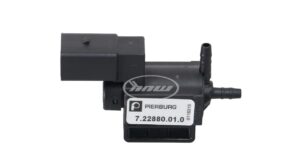
     

Part No.: 037906283CEA839. Equipped with a vacuum-controlled intelligent water pump, it features a static coolant sleep function. A baffle (also referred to as a vacuum-driven clutch cover) is installed between the water pump impeller and the housing. The telescopic movement of the clutch cover is controlled by engine vacuum pressure, and the on-off of the vacuum circuit is precisely regulated by the 037906283C solenoid valve.
 
Core Working Principle
 
✅ Solenoid valve energized → Vacuum supply connected → Clutch cover pushed over the impeller to enclose it tightly → Impeller idles, coolant circulation nearly suspended (minor circulation / no circulation), enabling rapid warm-up of a cold engine;
 
✅ Solenoid valve de-energized → Vacuum supply cut off → Clutch cover retracts to its original position under the force of the internal spring → Impeller fully engages in operation, the water pump switches to full-flow large circulation to ensure normal engine heat dissipation.
                                                                       
❌ Fault Causes and Typical Phenomena
        When the original four-hole water pump develops a leak, the lack of an anti-backflow design in the vacuum circuit allows leaked antifreeze and high-temperature steam to be directly sucked into the solenoid valve by negative pressure. The valve spool and spring inside the solenoid valve are not resistant to corrosion by antifreeze or erosion from high-temperature steam. Long-term exposure easily causes scaling, rusting, spool sticking and other issues, ultimately resulting in solenoid valve failure and triggering a series of subsequent malfunctions:
✅ Intermittent high water temperature (the most typical symptom): The instrument panel prompts “coolant temperature too high”, occurring irregularly, especially under working conditions such as traffic jams, high-speed driving and hill climbing. It functions normally when the engine is cold and occurs occasionally when the engine is hot; sometimes the fault disappears temporarily after a restart with no fixed fault code.
✅ Intermittent air conditioning cooling failure: When the water temperature rises excessively, the air conditioner stops cooling, and the cooling function returns to normal after the water temperature drops.
✅ Abnormal antifreeze consumption: The coolant level frequently runs low, and white crystals (residue from evaporated antifreeze) can be seen inside the engine compartment and near the water pump.
✅ Occasional fault codes: No definite fault code is displayed, or intermittent vacuum and water pump-related fault codes such as P0480, P2681 and P0504 are triggered sporadically.

    ⚠️ Key Maintenance Points: There are two solenoid valves of the same model 037906283C installed on the vacuum pipeline of the EA839 engine, which must be replaced in pairs synchronously and cannot be replaced individually. The two solenoid valves are arranged adjacently and share the same vacuum pipeline, located in a high-temperature area near the water pump and exposed to evaporating coolant vapor. Once one solenoid valve becomes corroded and stuck, the other will already suffer synchronous internal contamination, aging and spool wear, even if it has not completely failed temporarily. Replacing only one will highly likely lead to recurring faults in a short period. If only one is replaced, the old one will most likely fail within a few thousand kilometers, causing the fault to reoccur, which in turn increases maintenance costs and rework troubles. Meanwhile, clean the vacuum pipeline and replace with genuine coolant.

      III. Thermal Pneumatic Valve — The “Hidden Fault Point” of Water Circuit Switching

     Part Number: 06M121678F Thermal Pneumatic Valve, also known as Coolant Cut-Off Valve. It is installed at the front of the cylinder head of Cylinder Bank 2 next to the water pump, located at the end of the vacuum pipeline, and shares the same vacuum circuit as the water pump control. Its core function is to cut off the coolant flow to the cylinder block, allowing coolant to circulate only through the cylinder head, helping the engine warm up quickly and ensuring cold-start warm-up efficiency.
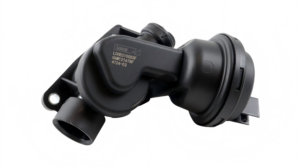
 
It adopts an internal mechanically rotating piston valve structure, consisting of key components such as a rubber diaphragm, vacuum chamber, spring, and waterway valve core. During operation, the opening and closing of the valve core are fully driven by the pushing and pulling force of vacuum. The vacuum negative pressure supply is entirely controlled by another solenoid valve with part number 037906283C.
         
Core Working Logic
 
  1. Solenoid valve de-energized: No negative pressure supply is connected. The spool remains open under the spring force, allowing the coolant to circulate normally.
  2. Solenoid valve energized: Negative pressure supply is connected. The internal spool rotates by 90 degrees to close the coolant passage, cutting off the water circuit of the cylinder block and enabling focused preheating of the cylinder head.
  3.                                      

❌ The cause of failure and internal damage symptoms are the same as those of the solenoid valve. The root cause of thermal pneumatic valve damage also stems from water pump leakage: leaked antifreeze and high-temperature steam will directly enter the interior of the thermal pneumatic valve along the vacuum pipeline, causing damage to internal components. The specific manifestations are as follows:

✅ Rubber diaphragm: swelling, hardening and rupture, resulting in vacuum air leakage and abnormal valve operation;

✅ Valve core/valve seat: scaling, crystallization and seizing, leading to failure of water circuit switching and inability to normally cut off and connect the cylinder water circuit;

✅ Spring: corrosion and elastic force attenuation, causing poor reset of the valve core and semi-stagnation, which affects warm-up efficiency and heat dissipation performance.

           IV. Thermostat Assembly (the “intelligent controller” for coolant circulation)
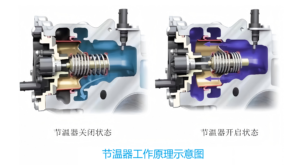
         

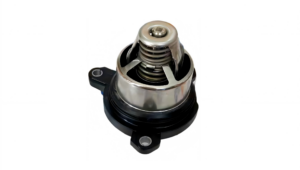
Electronically controlled heated thermostat fitted with part code: 06M121115HEA839 is mounted at the front of the cylinder block. Its core function is to precisely switch all coolant between the small circulation and large circulation circuits, maintaining stable engine temperature under various operating conditions. The Engine Control Unit (ECU) controls the heating element inside the thermostat wax core and adjusts the opening degree of the thermostat based on feedback signals from the coolant temperature sensor at the exhaust port:
 
  • Under partial load conditions: Maintain the coolant temperature at 105℃ to reduce internal engine friction;
  • Under high load conditions: Adjust the coolant temperature to 90℃ to ensure efficient heat dissipation.


      ❌ Common Causes of Damage


Thermostat damage falls into two categories, which are recommended to be inspected simultaneously:
 
  1. Natural aging damage: Aging and failure of the internal heating resistor; Long-term unchanged and deteriorated coolant forming scale deposits, leading to valve core sticking (stuck fully open or fully closed).
  2. Consequential damage: After water pump leakage, the back-siphoned coolant vapor directly corrodes the thermostat sealing seat, while precipitating scale crystals that cause valve core sticking and further aggravate cooling system faults.
 
V. Replace Water Pipe Sealing Rings Simultaneously (Preventive Maintenance)
 
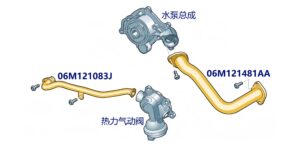
When replacing the four core components mentioned above (water pump assembly, solenoid valve, thermal pneumatic valve, thermostat assembly), replace the sealing rings of the two corresponding water pipes at the same time, or directly replace the water pipe assembly (with sealing rings). This eliminates slow leakage and rework repairs in the later stage and achieves one-time complete maintenance. The specific correspondence is as follows:
 
  1. Water Pipe Part No.: 06M121481AA
     
    Matching Sealing Ring: 06M121437E + WHT 007 920
  2. Water Pipe Part No.: 06M121083J
     
    Matching Sealing Ring: 06M121171 + WHT 005 652 A


VI. Two Other Common Frequent Faults of EA839: Oil Leakage + Mechanical Abnormal Noise

  Besides a series of cascading failures in the above-mentioned cooling system, the EA839 engine also has two inherent faults frequently encountered by car owners. These also require close attention; early detection and timely maintenance can prevent minor faults from escalating into major problems.

     Fault 1: Oil leakage from the oil filter base

    Oil leakage at the oil filter base of the EA839 engine is a perennial and common fault. The oil filter base is closely adjacent to the turbocharger and is exposed to high temperature baking from the turbo for a long time. The sealing rubber ring and base gasket are highly prone to accelerated aging, hardening and deformation under heat, gradually leading to oil seepage and oil soaking, which eventually develops into obvious oil leakage.


⚠️ Hazards: Engine oil leakage not only affects the cleanliness of the engine compartment, but also easily accumulates dust and debris, corrodes surrounding pipelines and wiring harnesses, posing potential safety hazards.
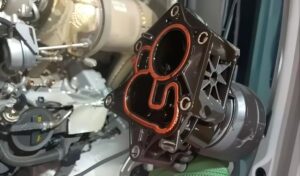
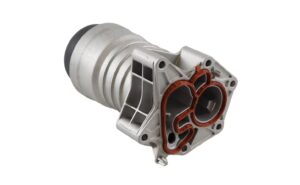


✅ Solution: Once oil stains or seepage marks are found around the oil filter base, it is recommended to replace the sealing gasket and the aged base in a timely manner to prevent the fault from further deteriorating.
           

Fault 2: Abnormal wear of valve rocker arm with tapping abnormal noise

After traveling a certain mileage, the EA839 engine is prone to abnormal wear of the valve rocker arms, resulting in increased fit clearance. The typical fault symptoms are very obvious, and vehicle owners can perform self-inspection directly: 1. The engine malfunction indicator light turns on; 2. Obvious vehicle body jitter occurs at idle speed.
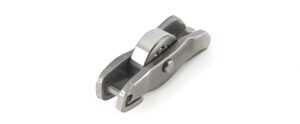

  1. There is a regular rhythmic mechanical tapping noise coming from the engine cylinder head. ⚠️ Hazard: If ignored for a long time without timely maintenance, the wear will worsen, directly scoring and damaging the camshaft, resulting in a multiplied increase in maintenance costs.


✅ Solution: Once jitter, malfunction indicator light illumination, or tapping abnormal noise from the cylinder head occurs, it is recommended to inspect and replace the valve rocker arm as soon as possible to avoid more severe mechanical damage in advance.
 
Summary: Core logic for completely fixing common faults of the EA839 engine
 
Most common faults of the EA839 engine center on a cascading failure of the cooling system, originating from the design defect of the original four-hole water pump. This subsequently causes damage to the solenoid valve, thermal pneumatic valve, and thermostat. Coupled with two other major issues—oil leakage at the oil filter base and abnormal noise caused by rocker arm wear—these constitute the high-frequency faults of this engine. Vehicle owners are advised to conduct regular inspections. If symptoms such as fluid leakage, abnormal noise, or abnormal water temperature are detected, perform standardized maintenance and replacement promptly. Avoid allowing minor faults to escalate into severe damage, which can reduce maintenance costs and extend the service life of the engine.


Table of Contents

Like this post? Share it on:

I’m Leo, the head of sales team at cowin. Me and my team would be happy to meet you and learn all about your business, requirements and expectations.

Carson
Paul
Tom
logo

Get More Benefits Since Submit The Info Form

Don’t worry, we won’t fill your inbox with spam”we can’t stand that either.

logo

Get More Benefits Since Submit The Info Form

I’m Leo, the head of sales team at Cowin. Me and my team would be happy to meet you and learn all about your business, requirements and expectations.
Carson
Paul
Tom

*We respect your confidentiality and all information are protected.

Latest Articles for You

Suspension System

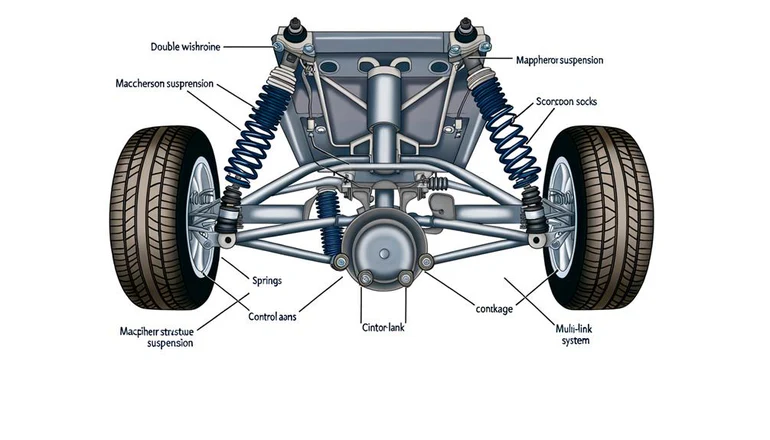
The suspension system is composed of coordinated components such as elastic elements (springs), dampers, and guiding mechanisms (control arms, stabilizer bars), appeg simple yet concealing intricate logic. Elastic elements absorb road impacts, dampers attenuate vibration amplitude, and guiding mechanisms ensure the correct wheel motion trajectory; the seamless cooperation of these thelements not only mitigates the jolts from bumpy roads but also maintains vehicle body posture during steering and braking, preventing roll and pitch, thereby balancing comfort

Read More »

Clutch System

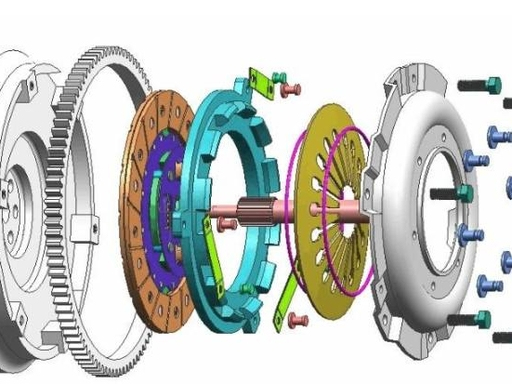
High-quality automotive clutch system featuring wear-resistant special material friction plates, designed for high-temperature resistance and reduced wear. Coupled with an optimized diaphragm spg design, it ensures uniform clamping force, delivering precise disengagement and smooth engagement. This guarantees stable torque transmission, maintaining long-term durability even under harsh operating conditions. By significantly reducing ovele operating costs, it is suitable for a wide range of vehicle types, including heavy-duty trucks and passenger cars.

Read More »

Brake System

Professional-grade automotive braking system, featuring a disc brake structure (or custom drum option), with brake discs manufactured using an integrated forging process for excelle dissipation. The brake pads are made of ceramic composite wear-resistant material, offering high-temperature resistance, anti-abrasion properties, stable friction coefficients, and efficient braking force transon. Equipped with high-precision brake calipers and seals, the system achieves a braking response time ≤0.3 seconds and a braking distance (fro 100km/h) ≤38 meters. It features Anti-lock Braking System (ABS) and Electronic Brake-force Distribution (EBD) to effectively prevent brake pull and wheel lock-up. Compaible with 220-240V electric vehicles, it balances braking performance, structural durability, and safety reliability, suitable for high-end passenger cars, heavy-duty commercial vehicles, and speose vehicles.

Read More »

Body system

Covering two major types, monocoque and body-on-frame, it offers customizable solutions tailored to vehicle types (passenger cars, commercial vehicles, special-purpoehicles) and usage conditions (private, commercial, off-road). Body accessories can be flexibly combined with configurations such as electric windows, central locking, and electric mirrors to enhance driving convenieand meet the personalized needs of different customers.

Read More »

Ignition Start System

From key ignition to push-button start, the evolution of ignition systems has always centered on convenience and reliability. Traditional key ignition relies on mechanical keys to triggts, offering a simple operation; push-button start systems utilize sensor recognition, eliminating the need to insert a key and allowing for ignition with a simple press, making them suitable for modern intellige. Regardless of the ignition method, the core mission remains to ensure rapid engine ignition and stable operation, preventing issues such as failed starts or poor ignition, and safeguarding every smo

Read More »

Cooling System

Professional-grade automotive cooling system featuring a high-efficiency tube-and-fin radiator with a large heat dissipation area and high efficiency, capable of a cing power of 5-20kW to meet the needs of engines with different displacements. The water pump employs a precision bearing design with stable rotation speed and controllableflow rate (5-15L/min), ensuring excellent sealing performance and eliminating leakage risks; the thermostat offers temperature control accuracy ≤±2℃, enabling precise switching between large and small circulatps to ensure rapid engine warm-up and stable heat dissipation. The cooling fan features intelligent temperature control, automatically adjusting its speed (100r/min) based on coolant temperature, with noise ≤55dB for energy-saving and quiet operation. Core components are made of corrosion-resistant and high-temperature special materials, having undergone multiple ets including high/low temperature, cyclic fatigue, and salt spray corrosion. Compatible with 12V/24V vehicle voltages, it balances heat dissipation performance, structura durability, and energy efficiency, suitable for high-end passenger cars, commercial vehicles, special vehicles, and various other scenarios..

Read More »
logo

Get More Benefits Since Submit The Info Form

*We respect your confidentiality and all information are protected.

Contact Us Right Now, Get Reply Today.

I’m Leo, the head of sales team at Cowin . Me and my team would be happy to meet you and learn all about your business, requirements and expectations.
Carson
Paul
Tom

Contact us