The Ultimate Solution for Electric Vehicle Sunroofs? Webasto Hides the Sunshade Inside the Glass
The sense of spaciousness brought by a panoramic sunroof was once one of the most appealing selling points of electric vehicles. But in summer, it reveals its true drawbacks: insufficient heat insulation, glaring light, and scorching heat on the top of the head, turning the “panoramic view” into “full exposure to the sun”.
Faced with this user pain point, the industry has provided two solutions: dimmable glass or traditional sunshades. However, the former is costly and offers limited heat insulation; the latter, as it occupies headroom, is often “sacrificed” in electric vehicles where battery packs have raised the floor.
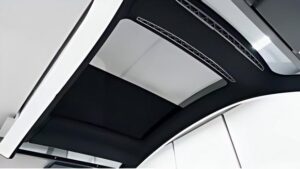
And now, Webasto has provided a brand-new solution – Shading in Glass (SIG). It makes no compromises on space, nor on cost, let alone sun protection effectiveness. It “hides” the sunshade inside the glass.
When “Panoramic Skylight” Meets “Space Anxiety”
The structural logic of electric vehicles is completely different from that of traditional fuel vehicles. The battery pack is laid flat on the chassis, which virtually occupies the vertical space of the cabin. For designers pursuing headroom, every millimeter must be carefully calculated.
The technical core of the 3D sky screen lies precisely in “structural innovation”.It cleverly “encapsulates” the sunshade curtain between the upper and lower pieces of glass, forming a sandwich structure of “glass-curtain-glass”. The sunshade curtain is no longer “parasitically attached” to the cockpit lining, but becomes an integral part of the glass assembly.
The direct benefit brought by this change is:
- Ultra-compact design: The overall thickness has been significantly reduced to make room for the precious headroom in electric vehicles.
- Structure simplification: The roof lining no longer requires reserved complex curtain boxes and guide rails, making the overall vehicle assembly more concise.
- Stronger adaptability: Whether it is a fastback coupe or a full-size SUV, the sunshade system can be easily installed without compromising the design.
Webasto tells the industry with “structural innovation” that the headroom of electric vehicles is not gained by “cutting down” configurations, but won back through “reconstructing” the design.
Physical Sun Shading VS Chemical Dimming
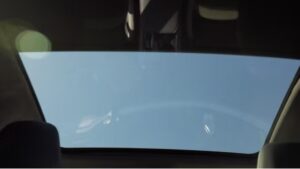
At present, many high-end electric vehicles choose to use dimmable glass (such as PDLC, EC) to replace traditional sunshades. This indeed brings a sense of technology with “one-touch dimming”, but in terms of users’ real experience, it has two unavoidable shortcomings
- Limited heat insulation effect: Light-adjustable glass mainly changes light transmittance rather than directly blocking infrared thermal radiation. Under intense sun exposure, the glass still accumulates a large amount of heat, and users can still feel the “heat wave” overhead.
- High costs persist: The complex manufacturing process and limited yield of dimmable glass result in a per-vehicle cost far exceeding that of traditional sunshade systems. For mainstream car models pursuing cost-effectiveness, this often serves as a deterrent
However, 3D sunshades have taken a different approach – returning to the “certainty” of physical sun protection.
When the sunshade curtain is closed, it effectively blocks direct sunlight and most of the thermal radiation, delivering an immediate and visible sun protection effect.