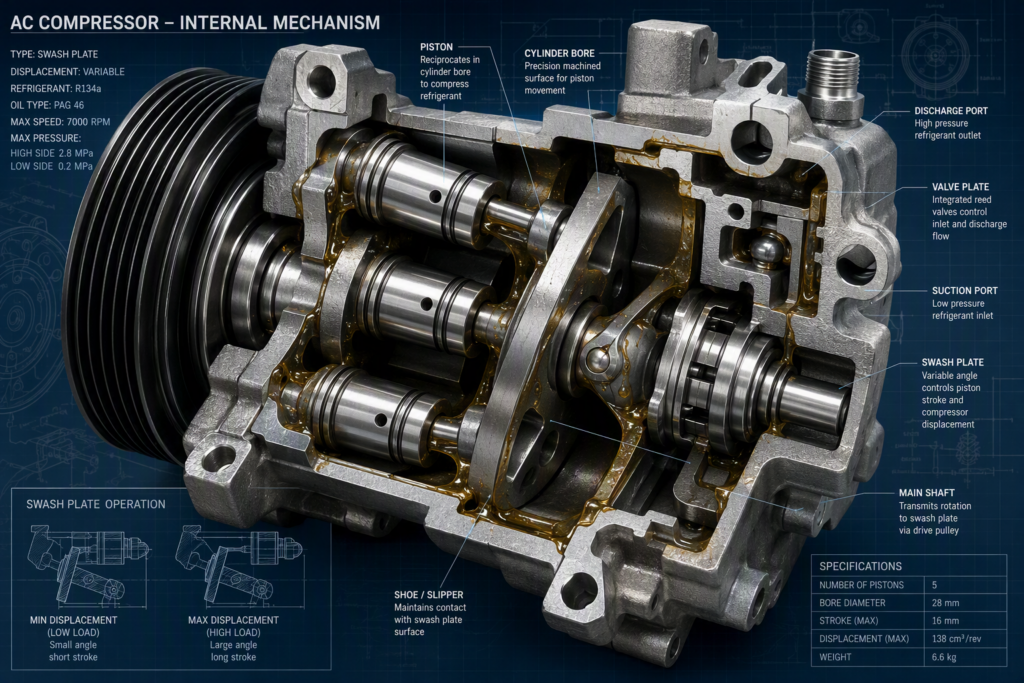
In the global auto parts wholesale market, the air conditioning (AC) compressor is often referred to as the “heart” of the HVAC system. However, for many distributors and fleet managers, it is also a primary source of warranty claims and customer dissatisfaction.
Why do some aftermarket compressors fail within 6 months, while OEM-spec units last for a decade? This article provides a deep technical analysis of compressor failure modes and the engineering standards required to ensure long-term reliability.
1. Mechanical Precision: The Micro-Gap Challenge
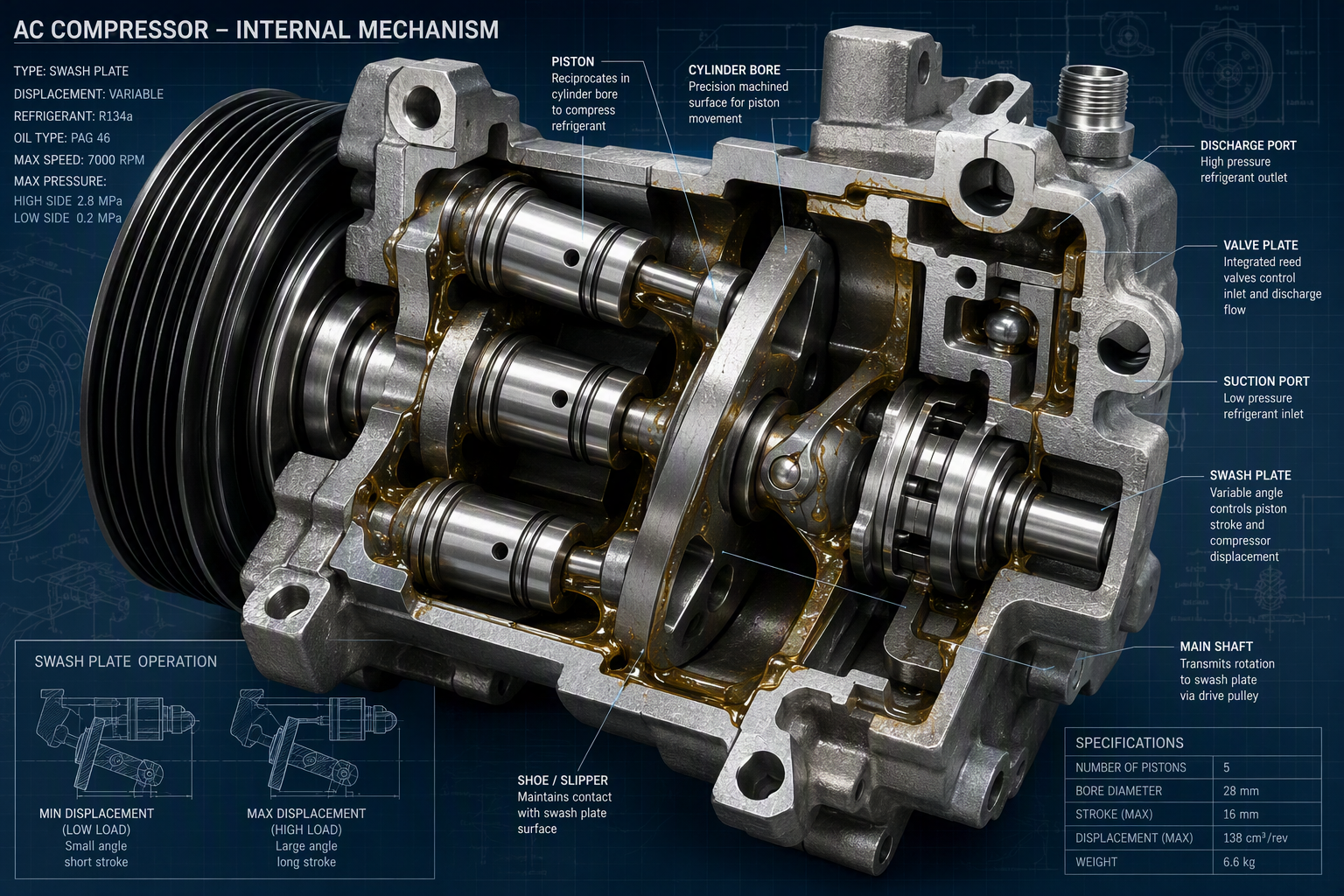
At the core of a swash-plate piston compressor (the most common type) are high-speed pistons moving within a cylinder block. The tolerance between the piston and the cylinder wall is measured in microns.
The Technical Pitfall:
Lower-quality manufacturers often use aluminum alloys with high thermal expansion coefficients. Under extreme summer heat, the piston expands faster than the cylinder block, leading to “Scuffing”—metallic friction that creates fine debris.
The COWIN Standard:
We utilize high-silicon aluminum alloys and apply a PTFE (Teflon) or tin coating to the pistons. This reduces initial friction during dry starts and maintains a consistent clearance even at operating temperatures exceeding 100°C.
2. The Chemistry of Cooling: Lubrication & PAG Oil
A compressor is essentially a chemical reactor. It must handle the phase change of refrigerants (R134a or R1234yf) while remaining lubricated by Polyalkylene Glycol (PAG) oil.
The Failure Mode: “Black Death”
When a compressor fails internally due to poor material quality, the resulting metallic powder mixes with the PAG oil, creating a thick, black sludge. This “Black Death” circulates through the entire system, clogging the expansion valve and destroying the condenser.
Technical Insight:
Moisture is the enemy. PAG oil is highly hygroscopic (it absorbs water). If a manufacturer does not use high-grade HNBR (Hydrogenated Nitrile Butadiene Rubber) seals, moisture enters the system, acidifies the lubricant, and causes internal corrosion.
3. The Role of the Swash Plate and Thrust Bearings
The swash plate converts rotational motion into linear piston motion. The point of contact between the swash plate and the piston shoes is a high-stress zone.
- Low-end units: Often use simple steel plates that wear down quickly under high-load cycles. • High-durability units: Use Hard-Chrome plated or Diamond-Like Carbon (DLC) coated swash plates.
- Combined with precision needle thrust bearings, these units can handle the rapid pressure spikes of modern “stop-start” engine technology.
4. Testing for the Real World: Beyond the Bench
To ensure a compressor can handle 100,000+ miles, laboratory testing must go beyond simple rotation.
At COWIN, our testing protocol includes:
- Durability Test: 500 hours of continuous operation at 140% of rated pressure.
- High-Speed Burst Test: Ensuring the housing integrity at RPMs exceeding 8,000.
- Real-Vehicle Simulation: Testing clutch engagement cycles (on/off) over 500,000 repetitions to ensure the electromagnetic coil doesn’t burn out under heat soak.
5. Strategic Sourcing Advice for Distributors
When sourcing AC compressors, price is a distraction; Total Cost of Ownership (TCO) is the metric that matters. A compressor that is 20% cheaper but has a 5% higher failure rate will eventually cost the distributor double in logistics, labor claims, and lost reputation.
Key Verification Checklist:
- Sealing: Ask for the seal material (HNBR is the standard).
- Coating: Confirm if pistons are PTFE or Tin coated.
- Valving: Verify the use of high-fatigue stainless steel for reed valves.
Conclusão
The automotive AC compressor is a masterpiece of precision engineering. By understanding the mechanical and chemical challenges these units face, global buyers can make informed decisions that reduce risk and increase profitability.
At COWIN, we don’t just supply parts; we supply engineering confidence. Whether it is our timing covers or our AC compressors, every component is built to exceed OE specifications.
For technical inquiries or to request our latest technical catalog, contact our engineering team at connie@cowin.cc.